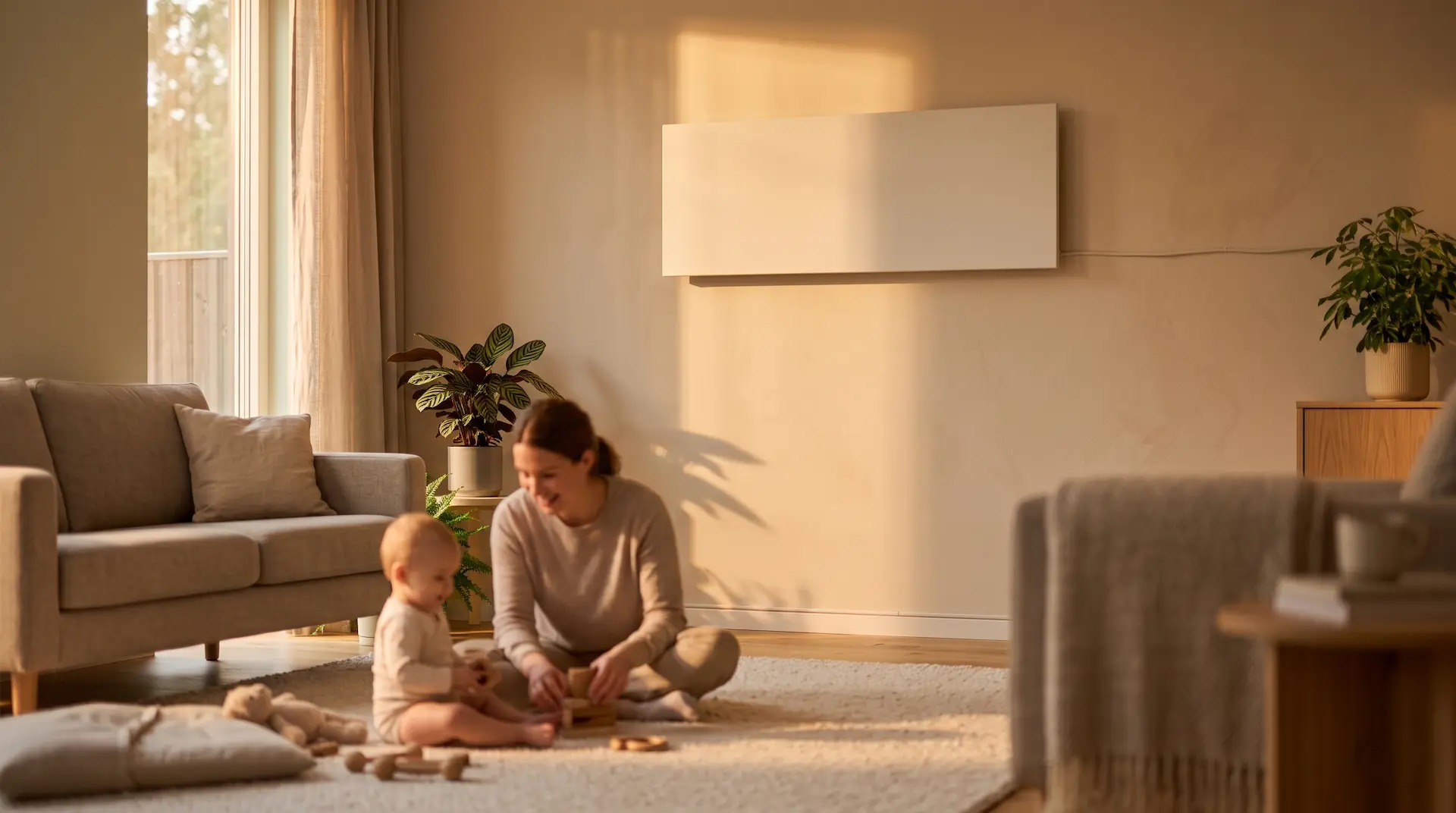
Many people researching infrared heating pause at the same question: "If it emits radiation, is it really right to use in my home, in my child's room?" It's a completely reasonable question, and it deserves a clear answer.
Let's start with a fact: that familiar warmth you feel on your face in winter sunlight is infrared radiation. The word "radiation," on the other hand, is a broad term covering everything from X-rays to radio waves — energies that are wildly different from one another. In this guide we explain where far infrared sits in the spectrum, what an international scientific commission has found, the safety measures built into Sunlike Tec products, and the rules you should follow — without alarmism, but without hiding anything either.
"Radiation" Isn't Just One Thing: The Electromagnetic Spectrum
The electromagnetic spectrum is a broad range stretching from radio waves to infrared, from visible light to UV and X-rays. The radiation within this range falls into two main groups.
- Ionizing radiation: radiation such as X-rays, carrying enough energy to knock electrons out of atoms. This is the group behind most of the concerns people associate with the word "radiation."
- Non-ionizing radiation: radio waves, infrared, and visible light belong to this group. Infrared is not ionizing, unlike X-rays or UV.
The infrared range spans roughly 780 nanometers to 1 millimeter. Far infrared (IR-C) is the region from around 3 micrometers to 1 millimeter. Under basic physics, the wavelength a surface emits depends on its temperature. A panel with a surface temperature of 90–120 °C emits energy in the far-infrared region; a panel at this temperature does not produce UV.
What Does the Science Say? ICNIRP's Assessment of Far Infrared
The International Commission on Non-Ionizing Radiation Protection (ICNIRP) published a comprehensive assessment of far-infrared exposure in 2006. The key findings are as follows:
- Depth: IR-C does not penetrate beyond the skin's outermost dead-cell layer (the stratum corneum).
- The main risk is thermal: the effect to watch for with far infrared is excessive heating and burns.
- Eyes: infrared-related cataract risk is largely associated with the near- and mid-wave bands (IR-A and IR-B). IR-C's contribution to heating the eye's lens is low.
- Repeated intense heating: repeatedly and intensely heating the same spot of skin over a long period can cause persistent redness. For this reason, prolonged direct exposure at very close range is best avoided.
In short, far infrared, used correctly, is a type of radiation whose primary concern is heat. That makes it manageable with the same common-sense precautions we already apply around a stove or any hot surface.
Product Safety at Sunlike Tec
Safety isn't just about physics — it's also about how the product is designed. The safety features built into Sunlike Tec products include:
| Feature | SL Series | OYKİ Series |
|---|---|---|
| Safety standard | EN 60335-2-30 (room heaters) | EN 60335-1 and EN 60335-2-30 series |
| Thermal protection | Bimetallic temperature switch | — |
| Protection class | IP54 | IP65 |
| Conformity markings | UKCA + CE | UKCA + CE |
UKCA is the conformity marking for the United Kingdom market, while CE is for the European Economic Area. The SL Series additionally complies with the LVD (Low Voltage), EMC (Electromagnetic Compatibility), RoHS, and WEEE directives. As with all electrical household appliances, the panels' electromagnetic compatibility is assessed within the framework of these directives.
The panels run on electricity with no combustion involved. They don't consume oxygen, and they don't produce combustion byproducts such as CO or CO2.
7 Rules for Safe Use
- Don't cover the front face. Don't place laundry, towels, or objects on the panel; doing so causes overheating and triggers the unit to shut off.
- Don't install it where it could fall into water. Stay away from locations like bathtubs and sinks.
- Don't use the SL Series outdoors. The SL Series is for indoor use; the OYKİ Series is designed for semi-open and large spaces.
- Don't touch the surface. Surface temperature reaches 90–120 °C. Mount the panel at a height, or on a ceiling, that's out of children's reach.
- Keep your distance. Avoid prolonged, direct exposure to heat at very close range directly in front of the panel.
- Have the electrical connection made by a licensed electrician.
- Cut the power and let it cool before moving it. There are no user-serviceable parts inside.
Frequently Asked Questions
Q: Is far-infrared radiation harmful?
Far infrared is not ionizing radiation like X-rays. According to ICNIRP's 2006 assessment, the primary risk with far infrared is thermal — that is, excessive heating and burns. Simple rules such as not touching the panel and avoiding prolonged direct exposure at very close range are how this risk is managed.
Q: Does an infrared panel emit UV rays?
No. Sunlike Tec SL panels have a surface temperature of 90–120 °C, and the energy a surface at this temperature emits falls in the far-infrared region. A panel at this temperature does not produce UV and will not tan the skin.
Q: Can an infrared heater damage your eyes?
According to ICNIRP, infrared-related cataract risk is largely associated with the IR-A and IR-B bands; far infrared's (IR-C) contribution to heating the eye's lens is low. Even so, as with any heat source, it's advisable to avoid looking at or being directly exposed to the panel from very close range for long periods.
Q: Can an infrared panel be used in a home with children?
Yes, it can be used; however, because the panel surface reaches 90–120 °C, it must not be touched. You need to mount the panel at a height, or on a ceiling, that's out of children's reach, and make sure the front face is never covered. You can plan the placement together with our experts.
Q: What happens if the panel overheats?
SL Series panels include protection via a bimetallic temperature switch. Covering the front face causes overheating and triggers the unit to shut off, which is why the front of the panel should always be left uncovered. The panels are designed to be mounted flush against a wall or ceiling.
Q: Can an infrared panel be used in a bathroom?
Per the user manual, the panel must not be installed where it could fall into water, such as near a bathtub or sink. In wet areas like bathrooms, we recommend determining the placement together with our experts and having the electrical connection made by a licensed electrician.
Q: What safety standards do Sunlike Tec panels meet?
The SL Series complies with the EN 60335-2-30 safety standard for room heaters, and the OYKİ Series complies with the EN 60335-1 and EN 60335-2-30 series. Our products carry the UKCA (United Kingdom) and CE (European Economic Area) markings. Please consult our experts regarding compliance with local regulations in different countries.
The Right Placement for Safe Warmth
Safe use starts with the right model and the right placement. To work out the right mounting point and model for your space, visit sunliketec.com or write to info@sunliketec.com. Phone: +90 850 304 94 34.
Sources
- ICNIRP – International Commission on Non-Ionizing Radiation Protection (2006). ICNIRP Statement on Far Infrared Radiation Exposure. Health Physics 91(6): 630–645.
- Sunlike Tec Product Catalog (2026)
- Sunlike Tec User and Installation Manual