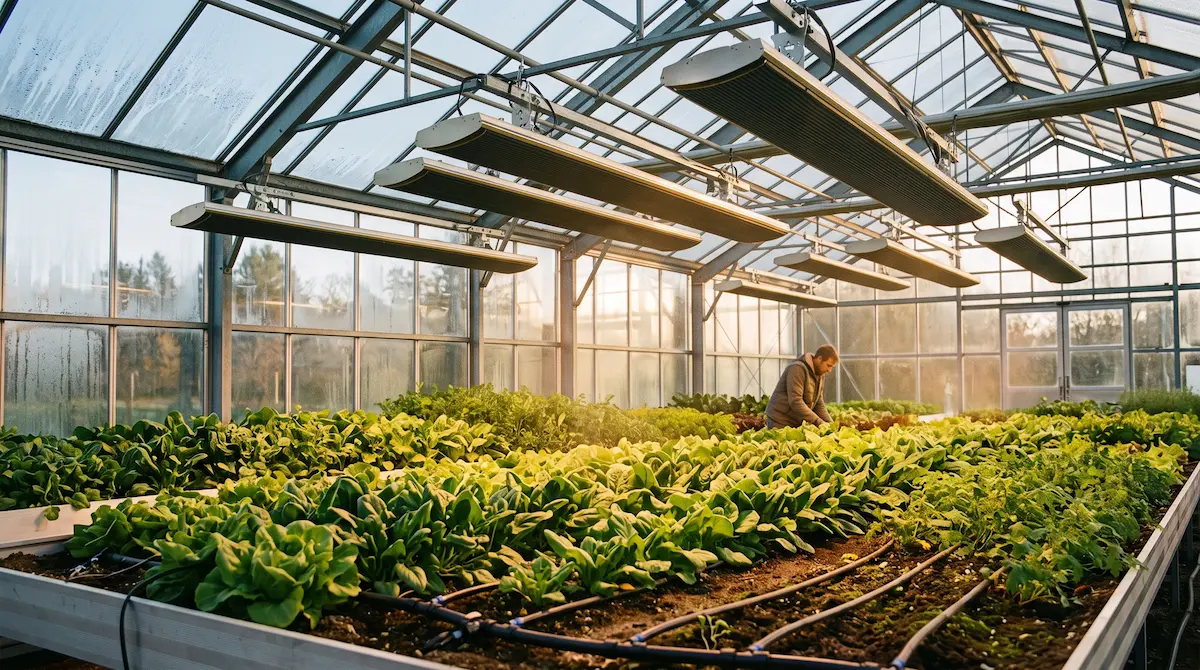
From the glass greenhouses of Northern Europe to the covered production areas of the Mediterranean, heating is a major operating cost in greenhouse growing. Keeping the greenhouse air at the desired temperature on cold nights in particular demands serious amounts of energy. What's more, hot air rises — part of that energy is lost into the empty space above the plants and up at the roof.
Yet it isn't the greenhouse air that needs to be warm — it's the plant itself. Sunlike's OYKİ Series is built on this simple but powerful idea: direct infrared heat straight to the plant canopy. In this article, we look at the findings of a scientific study, the relationship between humidity and disease risk, and correct planning for modern greenhouses.
The Blind Spot of Traditional Greenhouse Heating
In a greenhouse heated with hot air, energy is transferred to the air first, and that air is then expected to warm the plants. Because the greenhouse covering is thin, the warmed air quickly loses its heat to the outside.
This approach requires heating the entire volume just to warm the level where the plants sit. The result is energy spent on a volume that no plant actually needs. Picture a vegetable greenhouse in the Mediterranean with cool winter nights, or an ornamental-plant greenhouse in Northern Europe with a long winter season: in both cases, most of the heated volume is the empty space above the plants.
With infrared radiation, by contrast, energy reaches leaves, stems, and soil directly. Greenhouse air stops being the main carrier of heat.
What Does the Science Say? Findings from a European Production Greenhouse
A peer-reviewed study by Kavga, Konstas, and Panidis, published in 2015 in Applied Engineering in Agriculture, examined the effects of infrared heating in a production greenhouse operating in Europe.
The findings are striking: infrared heating kept the plant canopy at the ideal temperature while leaving the greenhouse air cooler. This produced a 35% to 45% reduction in energy consumption.
The logic is simple: the warmer the greenhouse air, the more heat is lost to the outside through the thin covering. When the air stays relatively cool while the plant is kept at its ideal temperature, less energy escapes through the covering.
In the interest of transparency: these results come from a single production greenhouse. The outcome in your own greenhouse may vary depending on climate, greenhouse structure, covering material, and the crop grown. That's why we evaluate every project according to its own conditions.
Humidity, Condensation, and Disease Risk
One of the biggest risks in greenhouses is condensation forming on leaf surfaces that cool down at night. The resulting film of water on the leaf creates a favorable environment for fungal diseases.
With infrared heating, the leaf surface itself is warmed directly. Because it stays warmer than the surrounding air, the tendency for condensation to form on the leaf decreases. This helps reduce moisture on the leaf surface and the associated disease risk.
This difference matters especially for night-time heating. The greenhouse air stays relatively cool while the plant reaches the temperature it needs.
Less humidity and lower disease risk lay important groundwork for healthy plant development and support the grower's yield goals. That said, heating still needs to be planned together with ventilation and climate control.
Infrared heating doesn't have to replace your existing climate-control infrastructure. It can also be set up as a supporting system for the greenhouse's critical zones or its coldest hours.
The OYKİ Series for Greenhouses
Sunlike's OYKİ Series of medium-density infrared heaters is the line developed for large industrial and agricultural spaces:
- IP65 protection: Protected against dust and water jets — a significant advantage in a greenhouse environment with irrigation and high humidity.
- 50,000-hour Aero-Tech element: Ceramic-coated, stainless-steel-sheathed construction.
- Anodized aluminum radiant plate: Directs heat toward the plants rather than into the air.
- Rock-wool rear insulation: Reduces energy loss toward the back — that is, toward the roof.
- Fully adjustable bracket: Allows heat to be aimed at the correct angle toward the canopy.
Model power ranges from 1500 W to 3200 W; the catalog's heated areas range from 15 m² to 32 m²*. The products run on 220–240 V and operate without combustion; they produce no combustion byproducts inside the greenhouse and consume no oxygen. The OYKİ Series is imported into Turkey under a UK license; it comes with a 3-year warranty and a 30-year service life. The products carry UKCA (United Kingdom) and CE (European Economic Area) conformity marks.
Heated area depends on insulation, usage pattern, and building construction. Heaters should not be used in sections exposed to wind.
Thanks to the adjustable bracket, heaters can be positioned according to row spacing and plant height; as plants grow, the angle can be readjusted. The layout plan is prepared together with our engineering team, taking ventilation openings into account.
Frequently Asked Questions
Q: Does infrared greenhouse heating really save energy?
In an independent study by Kavga and colleagues (2015) in a production greenhouse in Europe, infrared heating reduced energy consumption by 35–45%. This result belongs to a single greenhouse. The outcome in your greenhouse may vary depending on climate, greenhouse structure, covering material, and crop.
Q: Does infrared heating reduce humidity in a greenhouse?
Because infrared heating warms the leaf surface directly, it reduces the tendency for condensation to form on the leaf. This helps lower moisture on the leaf surface and the associated risk of fungal disease. Even so, heating should be planned together with ventilation and climate control.
Q: How does infrared heating work for night-time heating?
As the greenhouse air cools at night, OYKİ heaters direct energy straight to the plant canopy. This way, the greenhouse air stays relatively cool while the plant reaches the temperature it needs. Because the leaf surface is warmed, the tendency toward night-time condensation is also reduced.
Q: How many OYKİ heaters does a greenhouse need?
The quantity and mounting height depend on the greenhouse area, covering type, crop variety, and climate conditions. The catalog gives an approximate heated area for each model — for example, 24 m² for the OYKİ 2400+. Our engineering team performs the exact calculation specifically for your greenhouse.
Q: Can infrared heating be used alongside an existing greenhouse heating system?
Yes. Infrared heating doesn't have to replace your existing climate-control infrastructure. It can be set up as a supporting system for the greenhouse's critical zones or its coldest hours.
Q: Is the OYKİ Series resistant to the humid environment of a greenhouse?
The OYKİ Series has an IP65 protection rating; it is protected against dust and water jets. The ceramic-coated, stainless-steel-sheathed Aero-Tech element has a service life of 50,000 hours. Heaters should not be used in sections exposed to wind.
Q: Can the OYKİ Series be used in greenhouses in different countries?
The OYKİ Series runs on 220–240 V; it carries UKCA conformity marking for the United Kingdom and CE marking for the European Economic Area. In countries with different grid infrastructure, confirm electrical compatibility and local regulations with our specialists. For delivery and project support, you can write to info@sunliketec.com.
Get Engineering Support for Your Greenhouse
Share your greenhouse plan and product details with us, and let our engineering team design your heating project together with you. Request a survey via sunliketec.com or by writing to info@sunliketec.com. To reach us by phone: +90 850 304 94 34.
Sources
- Kavga, A., Konstas, I., Panidis, T. (2015). Assessment of Infrared Heating Benefits in a Production Greenhouse. Applied Engineering in Agriculture 31(1): 143–151. doi:10.13031/aea.31.10747 (a production greenhouse in Koropi, Greece).
- Sunlike Tec Product Catalog (2026)