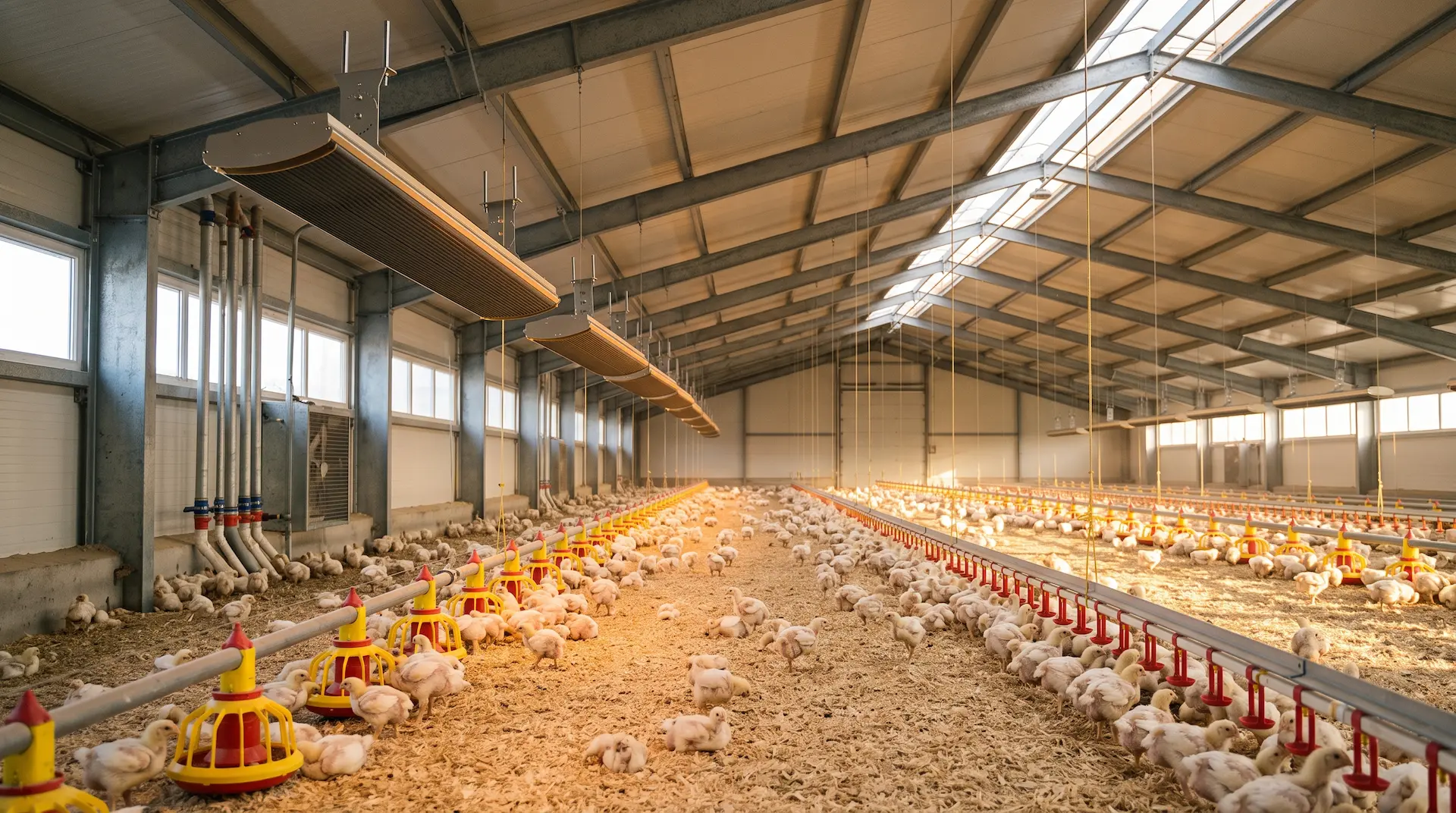
That sharp smell that stings your eyes the moment you step into a poultry house — sound familiar? Ammonia and dust are among the oldest, most universally known problems in poultry farming anywhere in the world. They directly affect animal comfort, the working conditions of caretakers, and ultimately production efficiency.
The job gets even harder in cold seasons — whether during Northern Europe's long winters or the cool nights of desert climates. Heat demand rises, ventilation gets throttled back, and the heating system keeps stirring dust into the air. So can heating be part of the solution instead of part of this cycle? Infrared heating is looking for exactly that answer.
Why Does Hot Air Cause Problems in a Poultry House?
Most conventional heating systems warm the air first, then circulate that hot air with fans or natural airflow. As the air moves, litter dust on the floor, feather particles, and dry droppings residue get stirred into the air as well.
What's more, hot air rises. As the warmed air collects near the ceiling, the floor level where the animals actually are can stay cooler than expected. The result: more energy is spent, but the heat doesn't fully reach the animals.
This is even more critical for chicks. In their early stage, the young need localized, balanced warmth. Getting heat to the right place in the right way is one of the core issues of the brooding period.
How Does Infrared Radiation Work?
Infrared heating resembles the way the Sun warms the Earth. Energy isn't spent heating the air; it's transferred directly to the animals, the floor, and surfaces via radiation. Because the heater doesn't move the air, it doesn't stir up dust.
Sunlike Tec's OYKİ Series is designed around this principle. The anodized aluminum radiant plate directs heat downward, into the living space. Rock-wool rear insulation reduces energy loss toward the ceiling and the back surface. The fully adjustable bracket makes it easy to focus the heat on the desired zone.
Because it runs on electricity without combustion, the OYKİ consumes no oxygen and produces no combustion byproducts (CO/CO2). It places no additional exhaust-gas load on the poultry house.
Another winner in this approach is the team working in the poultry house. An environment with less airborne dust, where heat is felt at the living level, makes maintenance, feeding, and inspection rounds more comfortable. Extra tasks like fuel tank management, flue cleaning, or burner adjustment also disappear.
What Does the Science Say? Cautious but Promising Findings
A comprehensive review published in 2024 in the journal Animals by Hayat and colleagues from Zhejiang University examines the potential of infrared radiation in the poultry industry. According to the study, infrared radiation may contribute positively to heating efficiency, the immune response of poultry, and the reduction of harmful gases.
We should be honest here: this is a review study, and the authors explicitly state that practical applications are still limited. The results are promising, but they're not a formula that guarantees the same effect in every poultry house. That's why we evaluate every project according to the facility's own conditions.
OYKİ Series for Demanding Poultry House Conditions
A poultry house is a harsh environment with dust, humidity, and regular washdowns. As stated in the catalog, the OYKİ Series is designed for demanding industrial environments as well as sterile settings. The series is protected against dust and water jets under the IP65 protection class. The ceramic-coated, stainless-steel-sheathed "Aero-Tech" heating element has a service life of 50,000 hours. The system requires no maintenance and runs odorless and silent.
| Model | Power | Heated Area* |
|---|---|---|
| OYKİ 1500+ | 1500 W | 15 m² |
| OYKİ 1800+ | 1800 W | 18 m² |
| OYKİ 2400+ | 2400 W | 24 m² |
| OYKİ 3200+ | 3200 W | 32 m² |
Heated area depends on insulation, usage pattern, and building construction.
The number of heaters required, mounting height, and layout plan vary according to the poultry house's dimensions, insulation, animal density, and regional climate. That's why, instead of estimating a figure, we carry out a project-specific engineering calculation. The OYKİ Series is designed for 220–240 V grids. One more note: the OYKİ is not suitable for use in windy conditions; in semi-open poultry houses, sections sheltered from wind should be preferred.
Frequently Asked Questions
Q: Does infrared heating completely eliminate ammonia in a poultry house?
No, infrared heating does not guarantee the complete elimination of ammonia in a poultry house. The 2024 review from Zhejiang University shows that infrared radiation can help reduce harmful gases, but the authors also note that practical applications are still limited. Ventilation and litter management are always necessary.
Q: How does an infrared poultry house heater work?
An infrared poultry house heater transfers energy directly to the animals, the floor, and surfaces via radiation instead of heating the air. Because it doesn't move the air, it doesn't stir up litter dust. In Sunlike Tec's OYKİ Series, the anodized aluminum radiant plate directs heat downward, while rock-wool rear insulation reduces energy loss.
Q: Are OYKİ heaters resistant to poultry house washdowns?
Sunlike Tec's OYKİ Series has an IP65 protection rating; it is protected against dust and water jets. The catalog states it is designed for demanding industrial environments as well as sterile settings. We recommend disconnecting the unit's power before cleaning.
Q: How many infrared heaters does my poultry house need?
The number of heaters required depends on the poultry house's size, insulation, animal density, and climate. OYKİ models are listed in the catalog with heated areas ranging from 15 m² to 32 m²; these values vary with insulation, usage pattern, and building construction. Sunlike Tec's factory engineering team determines the right model and quantity with a facility-specific calculation.
Q: Does an infrared heater consume oxygen in a poultry house?
No. Because Sunlike Tec's OYKİ Series runs on electricity without combustion, it consumes no oxygen and produces no combustion byproducts (CO/CO2). It therefore places no additional exhaust-gas load on the poultry house air.
Q: What is the lifespan and warranty of the OYKİ heater?
Sunlike Tec products come with a 3-year warranty and a 30-year service life. The ceramic-coated, stainless-steel-sheathed "Aero-Tech" heating element in the OYKİ Series has a service life of 50,000 hours. The system requires no maintenance.
Q: Can Sunlike Tec poultry house heaters be used in projects in different countries?
The OYKİ Series is designed for 220–240 V grids; for a different electrical infrastructure, you'll need to confirm suitability with our specialists. Sunlike Tec's product compliance documentation includes UKCA (United Kingdom) and CE (European Economic Area) marks. Consult our specialists during the project stage for compliance with local regulations and required documentation in your country.
Let's Plan Your Project Together for Your Poultry House
Every poultry house is different; the right heating starts with an engineering plan tailored to your facility and your region's climate. For a survey, needs analysis, and project evaluation, visit sunliketec.com, write to info@sunliketec.com, or reach us at +90 850 304 94 34.
Sources
- Hayat, K., Ye, Z., Lin, H., Pan, J. (2024). Beyond the Spectrum: Unleashing the Potential of Infrared Radiation in Poultry Industry Advancements. Animals 14(10): 1431. doi:10.3390/ani14101431
- Sunlike Tec Product Catalog (2026)
- Sunlike Tec User and Installation Guide