Heating is on, radiators are hot, yet your feet are still cold. The air near the ceiling is lukewarm while the chill at floor level never quite goes away. Whether you're in an apartment in Northern Europe or a villa on the Mediterranean coast, this isn't a usage mistake — it comes from the method itself.
Most conventional systems heat the air first and then wait for that air to warm you. Yet the one true heat source we've known for thousands of years works differently: the sun warms your face without heating the empty space in between. Sunlike Tec brings this natural method into living and working spaces with far-infrared panels. In this main guide you'll find the logic behind radiant heating, the brand's four principles, and the solutions suited to your sector.
Convection and Radiation: Two Different Heating Logics
In convection heating, energy is first transferred to the air. Warmed air becomes lighter and rises, while cooler air sinks. The result is heat that collects at the ceiling, persistent cold at floor level, and a constantly circulating air current. As the air moves, dust moves with it.
In radiant heating, energy travels in waves directly to the surfaces it encounters. Walls, floors, furniture, and people absorb this energy and warm up. Air stops being the main carrier of heat. The best-known example of this principle is the sun warming the Earth without heating the vacuum of space.
Warmed surfaces store heat for a while and release it slowly back into the room. This is why the sense of comfort feels more balanced and natural.
How Sunlike Tec Panels Work
SL Series far-infrared panels are 25 mm thick with a flat, smooth surface. Inside, a heavy-duty stainless steel resistance element sits on a ceramic (mica) substrate. Surface temperature averages 90°C, reaching 120°C on the SL 900 model. A bimetallic temperature switch and IP54 protection rating support safety.
The panels can be mounted flush against a wall or ceiling with no risk of overheating; the ceiling-mounted models sit directly into a standard 600×600 grid. For large, semi-open spaces such as warehouses, factories, and greenhouses, the IP65-rated OYKİ Series medium-density infrared heaters were developed.
All systems run on electricity, with no combustion. They consume no oxygen and produce no combustion byproducts such as CO or CO2. They are silent, odorless, and maintenance-free.
Four Principles: Eco-Friendly, Economical, Aesthetic, Healthy
Eco-friendly: Since there's no on-site combustion, there's no flue, no fuel tank, and no exhaust gas. The panels can be powered by electricity from renewable sources, such as a rooftop solar system.
Economical: Peter Kosack of TU Kaiserslautern in Germany compared two apartments in the same old building during the 2008/2009 heating season. Infrared heating consumed 71.21 kWh of final energy per square meter, while low-temperature gas heating consumed 208.73 kWh — 65.9% less. In the interest of transparency: this is an energy (kWh) comparison, not a cost comparison, and it is based on a single building over a single season.
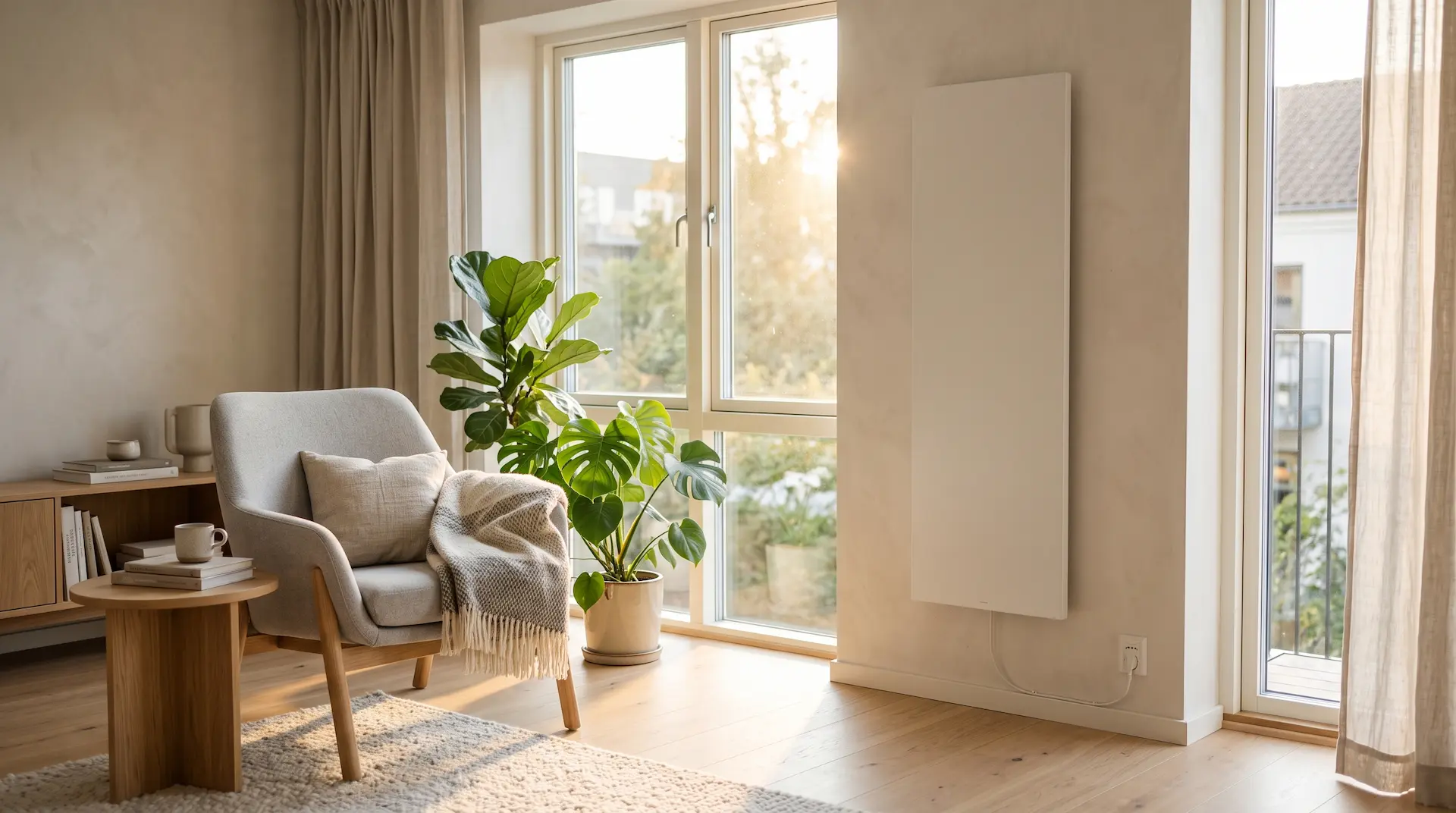
Aesthetic: The slim panel sits on the wall like a painting. With digitally printed surfaces or mirrored panel options, it becomes part of the décor.
Healthy: Because it doesn't move the air, it doesn't stir up dust, doesn't create a sensation of dry air, and doesn't consume oxygen. It heats like the sun, providing healthy comfort.
A line from our catalog sums up this approach: "We give our products a 3-year warranty, but we know they'll last 30 years." The SL Series is manufactured in Turkey under UK license. The products carry UKCA (United Kingdom) and CE (European Economic Area) conformity marks.
Solutions for Your Sector
The same physics answers very different needs in different corners of the world. A mountain cabin in Northern Europe, a yacht in the Mediterranean, or a greenhouse in Europe can all benefit from the same principle. Browse our detailed guides based on the area you're interested in:
- Home and living spaces: Comfort that doesn't stir up dust or create a sensation of dry air.
- Offices and retail stores: Invisible heating integrated into suspended ceilings.
- Large spaces: The OYKİ Series for factories, warehouses, and sports halls.
- Greenhouses: An approach that heats the plant canopy, not the air.
- Poultry houses: IP65-rated heating for dusty environments.
- Food drying: Infrared drying that acts like the sun.
- Caravans and tiny houses: Heat that takes up no space, at just 25 mm thin.
- Yachts and boats: Comfort against cabin humidity.
- Mountain cabins and villas: Fast installation without breaking into walls.
- Solar energy integration: Heating with the electricity you generate yourself.
- Carbon footprint and ESG: Sustainability goals through combustion-free heating.
- Practical installation: Setup that takes minutes, like mounting a TV bracket.
- Business partnership: Dealership and distributorship opportunities in the green transition.
- Aesthetics: Panels that look like art and heat like the sun.
Frequently Asked Questions
Q: What is infrared heating and how does it work?
Infrared heating is a method that delivers energy directly to people and surfaces through radiation rather than air. It works on the same principle as the sun warming the Earth. Warmed walls, floors, and furnishings store heat for a while and release it back into the room.
Q: Does infrared heating not warm the air at all?
The panel's target isn't the air — it's surfaces and people. Warmed surfaces indirectly warm the surrounding air to some degree. However, because air isn't the main carrier of heat, less hot air accumulates at the ceiling and air currents are reduced.
Q: Does an infrared panel use a lot of electricity?
Every panel has a defined power rating; for example, the SL 450 is 450 W. Total consumption depends on operating time, climate, insulation, and building structure. In the TU Kaiserslautern measurement, infrared heating consumed 65.9% less final energy (kWh) than gas; this result applies to a single building and a single season.
Q: Is infrared heating safe?
Infrared is non-ionizing radiation, unlike ionizing radiation such as X-rays; according to ICNIRP, far-infrared from known sources is normally of little to no practical concern. Because panel surfaces reach 90–120°C, they should not be touched directly and the front face should never be covered. Sunlike Tec panels include a bimetallic temperature switch, and since there's no combustion, no CO is produced.
Q: Infrared heating or a heat pump?
To be honest, according to the IEA, a typical heat pump produces roughly 4 times the heat for the electricity it consumes — it is more efficient per unit of electricity. Infrared stands out instead in well-insulated buildings with low heating demand, intermittently used spaces, and zonal heating, thanks to its easy installation and maintenance-free operation. It's also worth noting that Kosack's measurement compared infrared to gas, not to a heat pump.
Q: What is the warranty, lifespan, and origin of Sunlike Tec products?
All products carry a 3-year warranty and a projected 30-year lifespan. The SL Series is manufactured in Turkey under UK license; the OYKİ Series is imported to Turkey under UK license. The products carry UKCA and CE conformity marks.
Q: Can I use Sunlike Tec products in different countries?
Sunlike Tec products carry the UKCA conformity mark for the United Kingdom and the CE mark for the European Economic Area. The OYKİ Series runs on 220–240 V; confirm compatibility with your country's electrical infrastructure and local regulations with our experts. Since delivery and project support vary by country, you can write to info@sunliketec.com.
Let's Plan the Right Heating for Your Space Together
Every space has a different climate, insulation, usage pattern, and architecture. Visit sunliketec.com or write to info@sunliketec.com for a needs analysis; our experts will work with you to determine the most suitable model and layout. To reach us by phone: +90 850 304 94 34.
Sources
- Kosack, P. (2009). Comparative Measurements between Infrared Radiant Heating and Gas Heating Systems in Old Buildings. Research report, TU Kaiserslautern (Arbeitskreis Ökologisches Bauen).
- ICNIRP (2013). ICNIRP Guidelines on Limits of Exposure to Incoherent Visible and Infrared Radiation. Health Physics 105(1): 74–96.
- IEA (2022). The Future of Heat Pumps (World Energy Outlook Special Report).
- Sunlike Tec Product Catalog (2026)
- Sunlike Tec User and Installation Manual