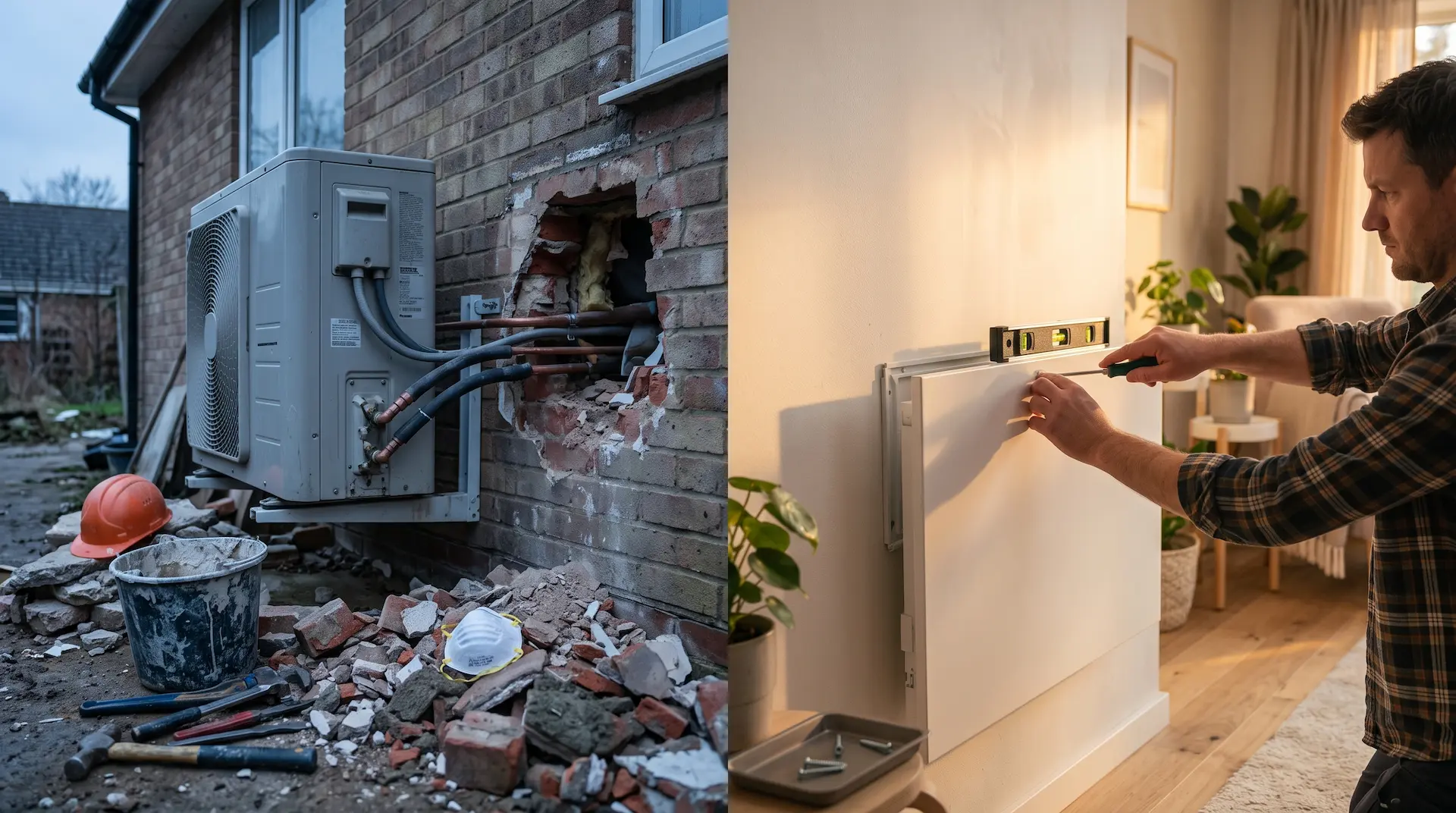
Choosing a heating system is a decision that affects a building for decades. In recent years, two solutions in particular have stood out: the heat pump, and electric infrared heating powered by rooftop solar. Both make it possible to heat a space without on-site combustion — but they work on completely different principles.
We're writing this article as an infrared heating brand. So we'll be upfront about our own technology's limits first. After that, we'll show — with a decision table — under which conditions a heat pump makes more sense, and under which conditions infrared + solar makes more sense. Our goal isn't to steer you toward a particular product, but to help you ask the right question for your building.
First, the Reality: Heat Pumps Lead on Conversion Efficiency
A heat pump doesn't so much produce heat as pull it from the outside environment and carry it indoors. Because of this, it yields more heat than the electricity it consumes. Heat pumps' seasonal performance factor is typically in the 3.5–5 range — meaning 1 kWh of electricity produces roughly 3.5–5 kWh of heat.
Direct electric heaters, infrared panels included, convert electricity into heat at a 1:1 ratio. 1 kWh of electricity is 1 kWh of heat.
The practical consequence of this difference is clear: in a large building with high, continuous, all-day heating needs, a heat pump delivers more heat per unit of electricity. In a building like that, it wouldn't be honest to recommend infrared as the primary system.
Where Infrared + Solar Is Strong
Infrared's advantage isn't its conversion ratio. Its advantage lies in how and where the heat is delivered, and in how the system is installed and used:
- Low investment and fast installation: No pipework, outdoor unit, or construction work required. Panels mount to a wall or ceiling with a TV-style bracket.
- Maintenance-free: Products carry a 3-year warranty and an expected 30-year service life.
- Delivers heat directly: Energy reaches people and surfaces, not the air.
- Zonal and intermittent use: Only the room in use can be heated, only during the hours it's needed. This flexibility matters in spaces that aren't used at full capacity every day — a holiday home, a mountain cabin, an office, or a hotel room.
- Quiet operation: The panel is silent and odorless.
- Direct use of solar electricity: Electricity generated on the roof can be converted directly into heat, with no additional conversion equipment.
One point should also be stated clearly when it comes to pairing with solar: the amount and timing of solar generation, and the timing of heating demand, differ for every project. This balance needs to be evaluated on a project-specific basis.
An Expert's View: Buildings with Low Heat Demand
Prof. Dipl.-Ing. Timo Leukefeld, an expert on energy-independent buildings, notes — in views reported by Focus Online (February 5, 2025) and Merkur.de (February 10, 2025) — that heating demand is falling in modern, well-insulated buildings. According to Leukefeld, in these buildings heat pumps can end up oversized given their high investment and repair costs. Infrared heating powered by solar electricity can be a more economical alternative in such cases.
This view should be read in context. It's an expert opinion as reported in a press article, not a universal rule for all buildings. Leukefeld's assessment applies specifically to buildings with low heat demand.
Decision Table: Which Building, Which Solution?
| Criterion | Heat pump may be more suitable | Infrared + solar may be more suitable |
|---|---|---|
| Building type | High heat demand, large, or poorly insulated building | Modern, well-insulated building; caravan, tiny house, mountain cabin |
| Usage pattern | Continuous heating, all day, in every room | Specific rooms, specific hours; seasonal or intermittent use |
| Heat demand | High and continuous | Low or localized |
| Investment priority | Long-term operating efficiency is the priority | Low upfront investment, fast installation, and no maintenance are the priority |
| Existing infrastructure | A structure that can support a central distribution system | A structure with rooftop solar (installed or planned) that doesn't want pipework |
A Hybrid Scenario: Using Both Together
The choice doesn't always have to be either/or. In a building where a heat pump covers the main heating load, specific zones can be supplemented with infrared panels:
- Bathroom: A space used for short periods during the day. The panel should be mounted away from points where it could fall into water, such as a bathtub or sink.
- Home office or a work corner: For heating just the area you're working in, without heating the whole house.
- Sunroom/conservatory: An interior space surrounded by glass surfaces where occasional extra comfort is wanted.
Frequently Asked Questions
Q: Which is more efficient — a heat pump or an infrared panel?
Per unit of electricity, a heat pump produces heat more efficiently; its seasonal performance factor is typically in the 3.5–5 range. An infrared panel converts electricity into heat at a 1:1 ratio. Infrared's advantage isn't its conversion ratio — it's low investment, no maintenance, zonal use, and delivering heat directly to people.
Q: Does solar-powered infrared heating make sense?
It can be a sensible solution, particularly in well-insulated buildings with low or intermittent heating needs. Because Sunlike Tec panels run on electricity, the electricity a solar (PV) system produces can be converted directly into heat. The balance between solar generation and heating demand should be assessed on a project-specific basis.
Q: Can an infrared panel replace a heat pump?
That depends on the building. In buildings with high, continuous heating needs, a heat pump is generally the more suitable primary system. In modern, well-insulated, or zonally used spaces, infrared can be considered as the primary heating method.
Q: Can a heat pump and an infrared panel be used together?
Yes. While a heat pump covers the main heating load, specific areas such as a bathroom, home office, or sunroom can be supplemented with infrared panels. This hybrid approach makes it easier to give each zone exactly the heat it needs.
Q: What's the maintenance and lifespan of an infrared panel?
Sunlike Tec panels require no maintenance. Products come with a 3-year warranty and an expected 30-year service life.
Q: How complicated is infrared panel installation?
SL Series panels mount to a wall or ceiling in six steps using the TV-style bracket on the back; no pipework, outdoor unit, or construction work is required. We recommend having the electrical connection made by a licensed electrician.
Q: Do you support projects in different countries?
Yes — you can request a project assessment via sunliketec.com or info@sunliketec.com. Our products carry the UKCA (United Kingdom) and CE (European Economic Area) markings. Compatibility with your country's electrical infrastructure and local regulations is confirmed together with our experts.
The Right Answer Depends on Your Building: Let's Evaluate It Together
Heat pump, infrared + solar, or a combination of the two? The answer depends on your building's insulation, usage pattern, and heat demand. For a project assessment, visit sunliketec.com or write to info@sunliketec.com. Phone: +90 850 304 94 34.
Sources
- autarc.energy. Heat pump or infrared heater: An overview of the comparison (online guide): typical seasonal performance factor for heat pumps is 3.5–5.
- IEA (2022). The Future of Heat Pumps (World Energy Outlook Special Report): a typical residential heat pump's COP is approximately 4.
- Focus Online (February 5, 2025). News article covering Prof. Dipl.-Ing. Timo Leukefeld's views on infrared heating and heat pumps (relayed via a VASNER press summary; the original headline is to be confirmed before publication).
- Merkur.de (February 10, 2025). Press article covering Prof. Dipl.-Ing. Timo Leukefeld's views on infrared heating and heat pumps.
- Sunlike Tec Product Catalog (2026)
- Sunlike Tec User and Installation Manual