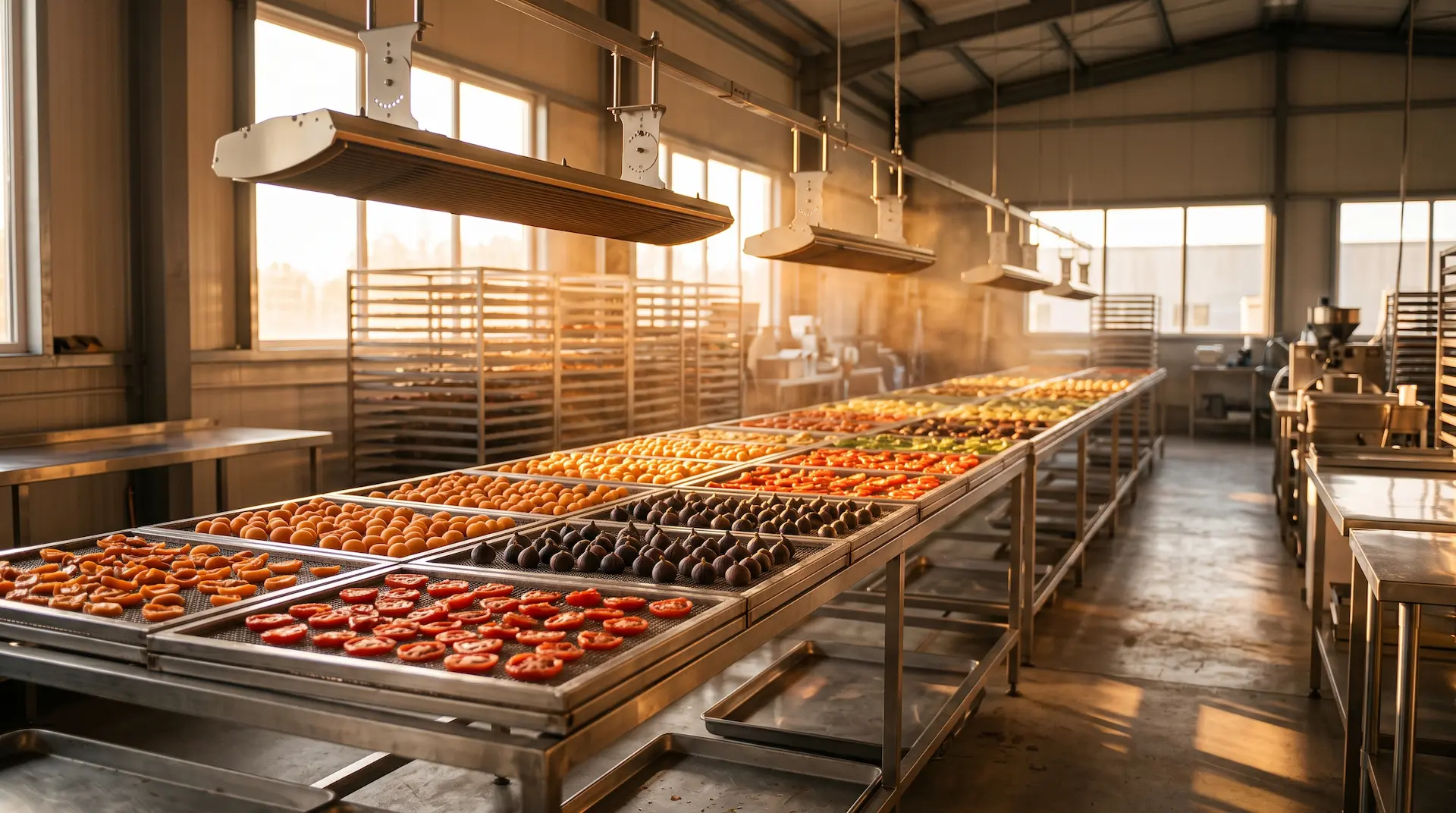
From the Mediterranean basin to the Middle East, dried products — from apricots to figs, tomatoes to peppers and spices — have been part of tables and trade for centuries. Today these products travel between continents. But competition is no longer won on volume alone; it is won on color, aroma, and naturalness.
Traditional sun-drying is the foundation of this heritage, but it is exposed to weather conditions, dust, and long waiting times. Dryers that work with hot air, on the other hand, can harden the surface of the product and cause color change. So is it possible to recreate the sun's natural effect in a controllable facility environment?
How Does Infrared Drying Work?
The sun dries fruit not by heating the air, but through radiation. Infrared drying is based on the same principle. Instead of being spent heating the air, energy is transferred directly to the surface and texture of the product.
This direct transfer allows heat to reach the product faster. Because the heater does not move the air, it does not stir up dust. This keeps the drying area a more controlled environment.
In the Sunlike Tec OYKİ Series, an anodized aluminum radiant plate directs heat to the targeted area. Rock wool backing insulation reduces energy loss. A fully adjustable bracket makes it easy to position the heat according to product shelves or belts.
What Does Science Say? Shorter Time, Preserved Quality
A study published by Zartha Sossa and colleagues in 2021 in Frontiers in Sustainable Food Systems examines infrared drying trends in fruit. According to the findings, infrared drying can offer a shorter processing time compared to other methods while preserving the composition and sensory properties of the product to a high degree.
The same study also underlines an important point: results depend on the product and the temperature setting. For example, a high far-infrared temperature can affect vitamin C in kiwi. In other words, infrared drying is not a magic button; it is a powerful tool when set correctly.
That is why we do not say it "preserves everything." We say that, with the right temperature and time settings, infrared drying helps preserve color, composition, and nutritional value.
Preserving Naturalness Without Chemical Pretreatment
In dried products, color is the first feature a consumer notices. Controlled infrared drying, depending on the product and setting, can make drying possible without the need for chemical pretreatment. In a properly planned process, the risk of browning and caramelization is reduced, and the product's original color can be preserved.
This is an important value proposition for markets seeking natural, additive-free products. The standout advantages of infrared drying can be summarized as follows:
- Shorter processing time, thanks to heat being transferred directly to the product
- Helps preserve color, composition, and sensory properties
- Controllable production independent of weather conditions
- A heat source that does not move the air and does not stir up dust
For exporters, this picture is not just a production decision — it is a brand decision. Being able to offer a product with consistent color and similar quality from batch to batch is one of the most solid ways to earn a buyer's trust in any market. A process independent of weather conditions also makes delivery schedules more predictable. For example, a spice facility in the Middle East or a dried-fruit business in the Mediterranean can adjust the same controlled process to its own product.
The OYKİ Series for Food Facilities
Food facilities require moisture resistance, cleanliness, and continuous operation. The OYKİ Series is protected against dust and water jets with an IP65 protection rating. As stated in the catalog, it is designed for demanding industrial environments and sterile environments.
The ceramic-coated, stainless-steel-sheathed "Aero-Tech" heating element has a service life of 50,000 hours. The system requires no maintenance; it operates odorlessly and silently. Because it is electric and flameless, it produces no combustion byproducts. The series is designed for 220–240 V grids.
| Model | Power | Dimensions (mm) |
|---|---|---|
| OYKİ 1500+ | 1500 W | 1045×177×60 |
| OYKİ 1800+ | 1800 W | 1225×177×60 |
| OYKİ 2400+ | 2400 W | 1505×177×60 |
| OYKİ 3200+ | 3200 W | 1915×177×60 |
How many heaters a drying line requires, the heater-to-product distance, and the processing time vary according to the product, capacity, and facility layout. We do not estimate these values. Our factory engineering team designs a project specific to your facility.
Frequently Asked Questions
Q: Does infrared drying preserve the vitamins in food?
Scientific literature shows that infrared drying can preserve the composition and sensory properties of food to a high degree. However, the result depends on the product and the temperature; for example, a high far-infrared temperature can affect vitamin C in kiwi. The right temperature setting helps preserve nutritional value.
Q: How does infrared food drying work?
Infrared food drying transfers energy directly to the surface and texture of the product through radiation, rather than by heating the air — similar to how the sun dries fruit. Because the heater does not move the air, it does not stir up dust. This direct transfer allows heat to reach the product faster.
Q: Which products can be dried with infrared?
Scientific literature on infrared drying focuses predominantly on fruit. For products such as apricots, apples, tomatoes, or spices, suitability and settings are evaluated specifically for the product during the project design stage.
Q: Does infrared drying require chemical pretreatment?
Controlled infrared drying, depending on the product and temperature setting, can make drying possible without the need for chemical pretreatment. In a properly planned process, the risk of browning and caramelization is reduced, and the product's original color can be preserved. The exact result should be evaluated separately for each product.
Q: Can OYKİ be integrated into my existing drying facility?
The fully adjustable bracket structure of the Sunlike Tec OYKİ Series makes it easy to integrate into existing shelf or belt systems. Suitable placement, heater-to-product distance, and quantity are determined through our engineering team's facility-specific assessment.
Q: What is the service life and warranty of the OYKİ food-drying heater?
Sunlike Tec products come with a 3-year warranty and a 30-year service life. The "Aero-Tech" heating element in the OYKİ Series has a service life of 50,000 hours. The IP65-protected system requires no maintenance.
Q: Can Sunlike Tec drying solutions be used in facilities in different countries?
The OYKİ Series is designed for 220–240 V grids; for a different electrical infrastructure, you need to confirm suitability with our experts. Sunlike Tec products' compliance documentation includes UKCA (United Kingdom) and CE (European Economic Area) markings. For compliance with the food and electrical regulations of the country where your facility is located, please consult our experts during the project stage.
Let's Design Your Custom Drying Solution Together
Preserving your product's color, aroma, and value starts with the right engineering. For discovery, needs analysis, and project evaluation, visit sunliketec.com, write to info@sunliketec.com, or reach us at +90 850 304 94 34.
Sources
- Zartha Sossa, J.W. et al. (2021). Infrared Drying Trends Applied to Fruit. Frontiers in Sustainable Food Systems. doi:10.3389/fsufs.2021.650690
- Sunlike Tec Product Catalog (2026)